


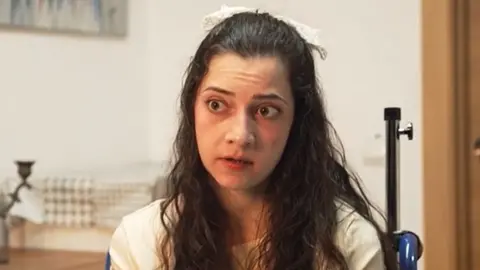
 Y Ahora Sonsoles (Atresmedia Television)
Warning: This story contains references to sexual violence and suicide.
The death by medically assisted death of a twenty-five-year-old Spanish woman after a lengthy court fight with her father has sparked discussion about the responsibility of the government in caring for her and why it took so long to implement her desire to end her life.
Noelia Castillo, who had been rendered paraplegic due to injuries suffered when she attempted to end her life in 2022, died on Thursday evening at a Barcelona hospital.
The Catalan local authorities had granted her the right to euthanasia in the year 2024.
However, the procedure was suspended at the last moment after legal objections raised by her father, supported by the advocacy organization a Christian legal group.
The situation has received significant attention in the country, with Christian Lawyers trying to prevent her passing until the very end.
After an 18-month court fight, the Strasbourg court decided this week in Noelia Castillo's favour and her death was finally confirmed in the late hours on Thursday.
A Troubled History
Castillo had spent much of her childhood in state institutions and had described the impact on her mental health of her father's issues with drinking and of being assaulted by an former partner and also by a number of individuals in a club.
In a TV interview this week, she said no one in her immediate family had backed her decision to die by euthanasia, and her father "hasn't respected my decision and never would".
"I want to pass in calm now and stop my pain," she told a TV network the day before she died.
Her parent had not agreed with her decision but joined her at the clinic.
A former friend of her, Carla Rodríguez, tried to enter the clinic to persuade her to reconsider, but informed media that officers had barred her from entering.
A British musician residing in the country issued an appeal to her via online platforms to think again and offered to cover her healthcare expenses until she felt "in a position to make this decision from a somewhat more peaceful state of mind".
Institutional Failures Questioned
The legal group argued that her case had highlighted failures in her support.
"For a young woman who clearly has had a very tough life, which we all are sorry for, the only thing that could be offered to her by the healthcare system is to die," said a representative for the group.
The main conservative political group, which voted against a 2021 euthanasia law, had a similar reaction.
"The institutions that should have safeguarded Noelia failed her," wrote the group's leader on social media. He added: "I decline to accept that the state did not have the tools to give her care."
In a statement, the Church, said that Castillo case "reflects an accumulation of individual pain and systemic letdowns".
Judicial Hurdles and Backing
However, other observers have taken issue with the fact that her wishes were blocked by legal obstacles placed in her way by her parent and the Christian lawyers.
"The wish to bring an end to her pain by using the right to euthanasia was… undermined by a lengthy court fight that added nearly two years of suffering to her existence," commented a left-leaning publication in an opinion piece.
A lawmaker for a left-wing platform said that "19 doctors have supported her choice and we should be respectful of it", while adding that it was a "profoundly complicated" matter.
The Country's Assisted Dying Law
Spain is one of a small number of European countries, such as the Holland, Belgium and Luxembourg, that have passed laws allowing medically assisted death to be performed by physicians.
Under the 2021 law, any Spanish person over 18 requesting assisted dying must be afflicted by an incurable disease or "severe, long-term and incapacitating ailment" and their choice must be made without external pressure.
The decision needs to have been made twice in written form and has to be validated by a physician who then consults with a second medical professional.
The application then goes to a review committee, which has the role of assessing if the requirements have been met.
Based on government data, 426 requests for assisted dying were granted in 2024, the most recently completed year for which data is available. This was the initial instance that a case was taken to a judge for a court to rule.


